

Benefits of Olive Oil Soap: A 2026 Guide

Table of Contents
- What Makes Olive Oil Soap Different
- Olive Oil Soap for Sensitive Skin
- Olive Oil Soap vs Commercial Soap
- Is Olive Oil Soap Non-Comedogenic?
- The Role of Laurel Oil and Traditional Craftsmanship
- How to Identify Quality Olive Oil Soap
- Frequently Asked Questions
Last Updated: September 30, 2026
What Makes Olive Oil Soap Different
The benefits of olive oil soap start with what it leaves out. Most store-bought bars are built from synthetic detergents, fillers, and hardening agents that strip the skin. Olive oil soap instead uses a simple reaction between olive oil and lye to produce a bar that cleans gently while keeping its natural glycerin intact.
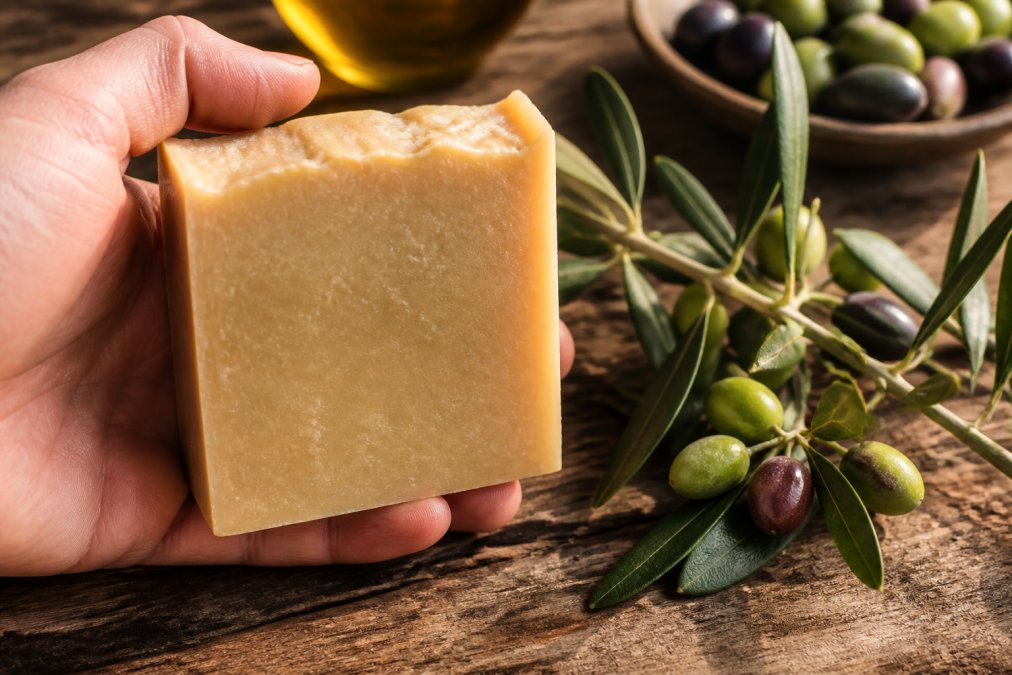
The Saponification Process and Natural Glycerin
Saponification determines how a bar feels on your skin. When olive oil meets sodium hydroxide, the fatty acids split into soap molecules and glycerin. The glycerin stays bound in the finished bar, separating a moisturizing soap from a drying one.
Olive Oil Soap for Sensitive Skin
Olive oil soap for sensitive skin works because it avoids the ingredients most likely to trigger irritation: fragrance blends, synthetic surfactants, and preservatives.
Hypoallergenic and Dermatological Considerations
A dermatological approach to soap selection focuses on pH and barrier function. Traditional olive oil soap sits around a neutral to mildly alkaline pH, higher than skin's acidic mantle. Most people tolerate this fine, but reactive skin may prefer a pH-buffered bar or a follow-up toner.
Olive Oil Soap vs Commercial Soap
The olive oil soap vs commercial soap comparison comes down to three things: what cleans, what stays, and what gets added. Commercial bars rely on synthetic surfactants for lather, effective degreasers that leave skin tight and dry.
| Feature | Olive Oil Soap | Commercial Soap |
|---|---|---|
| Cleansing agent | Saponified olive oil (sodium olivate) | Synthetic surfactants |
| Glycerin | Retained naturally | Often removed |
| Common additives | None or botanicals | Parabens, fragrance, dyes |
| Lather | Creamy, low-foam | Dense, high-foam |
| Effect on skin | Emollient, gentle | Can be drying |
Synthetic Surfactants and Paraben-Free Formulas
Synthetic surfactants are the workhorses of mass-market soap and are not inherently dangerous. The problem is they are often paired with parabens and artificial fragrance to extend shelf life and mask raw ingredient smells. A paraben-free, fragrance-free olive oil bar sidesteps that category of additives.
The pH Difference Most Guides Skip
True soap, including saponified olive oil, is chemically alkaline, typically landing well above the roughly 4.5 to 5.5 acidic mantle your skin maintains. That gap is not automatically bad: skin re-acidifies shortly after washing, and most people never notice.
How to Read a Commercial Soap Label
You do not need a chemistry degree to tell the two categories apart. Look at the first three ingredients.
- True olive oil soap: the list reads like a recipe, olive oil (or sodium olivate), water, sodium hydroxide. If laurel oil is present, it appears as laurus nobilis or laurel fruit oil.
- Syndet bar: the first ingredient is usually a surfactant name ending in -ate, -sulfate, or -betaine (sodium lauroyl isethionate, sodium laureth sulfate, cocamidopropyl betaine). Glycerin, if present, is listed as an added ingredient rather than a byproduct of saponification.
- Hybrid bars: some mass-market bars combine a small amount of saponified oil with synthetic surfactants. These are not dishonest, but they are not what most people mean by "olive oil soap."
Is Olive Oil Soap Non-Comedogenic?
Olive oil soap is generally considered non-comedogenic, meaning it is unlikely to clog pores. The key word is "generally": oleic acid, olive oil's dominant fatty acid, is heavier than the linoleic acid in lighter oils, and for some acne-prone people that weight can contribute to congestion.
The Role of Laurel Oil and Traditional Craftsmanship
Laurel oil separates a basic olive oil bar from a traditional one. Made from laurel tree berries, it adds a dense, creamy lather and a green tint. In traditional soap-making regions, laurel oil has been blended with olive oil for centuries, and the ratio marks quality.
How to Identify Quality Olive Oil Soap
Quality olive oil soap is identifiable before you open the wrapper. The ingredient list should read like a short recipe: olive oil, water, sodium hydroxide, and perhaps laurel oil or a botanical additive. A long list with synthetic surfactants or artificial fragrance is not the real thing.
MEN'S COLLECTION Tobacco Caramel →
Here is a quick checklist for evaluating any bar:
- Olive oil is the first or second ingredient listed
- No synthetic surfactants, parabens, or artificial dyes
- Color is naturally green or cream, not dyed
- Scent is faint and plant-based, not perfumed
- Bar feels firm but not rock-hard
- Glycerin is retained, not listed as an added ingredient
Spotting a Fake or Diluted Bar
Most "olive oil soap" on a big-box shelf is not lying, it is diluting. A bar can legally be called olive oil soap while olive oil sits fourth or fifth on the ingredient list, behind tallow, palm oil, and a surfactant. Here is how to tell before you buy.
- Ingredient order is the tell. In the U.S., ingredients are listed by weight in descending order. If olive oil (or sodium olivate) is not first or second, the bar is mostly something else.
- "Made with olive oil" is not the same as "made from olive oil." The first phrase can describe a bar that contains a token amount. The second describes a bar where olive oil is the primary fat.
- Watch for "sodium tallowate" or "sodium palmate" near the top. These are rendered animal fat and palm oil, respectively. They are not harmful, but they mean the bar is not what you are paying for.
- Beware of bright, uniform color. Genuine olive oil soap ranges from pale cream to muted green depending on the oil and any laurel content. A vivid green or blue bar is almost certainly dyed.
- A hard, glossy, perfectly rectangular bar signals industrial pressing and hardening agents. Traditional olive oil soap tends to be softer, slightly irregular, and matte.
- The scent test. Real olive oil soap smells faintly of olive, or of whatever botanical was added. A strong, lingering perfume is synthetic fragrance.
DIY vs. Store-Bought: What to Know Before You Choose
Making olive oil soap at home is possible, a cold-process reaction between olive oil and lye, but it is not a casual weekend project. The two paths have real trade-offs.
DIY risks to take seriously:
- Lye (sodium hydroxide) causes chemical burns. Gloves, eye protection, and ventilation are not optional.
- A bar that has not fully saponified, a "lye-heavy" batch, will irritate skin. This is why recipes specify a lye calculator and a cure time measured in weeks, not days.
- Homemade bars have no preservative system. That is fine for a simple olive oil bar, but any bar with added milk, fruit, or fresh botanicals can grow mold.
- Without a pH test strip, you cannot confirm the finished bar is skin-safe. A strip costs a few dollars and is worth using on every batch.
Storage and Shelf-Life Tips
Shelf-life by storage method:
- Cool, dark, dry cabinet in breathable paper: a year or more
- Bathroom shelf in a draining dish: a few months of active use
- Sealed plastic wrap in a warm bathroom: weeks, and prone to sweating and softening
- Refrigerator (wrapped, in a sealed bag): extends life significantly, but the bar should come to room temperature before use to avoid condensation
The finished product from a small-batch maker like Gracie & Co. 1942 reflects this care. Our Tobacco Caramel Premium Coconut Milk Soap pairs olive oil with shea butter and coconut milk for a creamy lather, and the ingredient list stays short and readable.

Frequently Asked Questions
Is olive oil soap good for your skin?
Olive oil soap is rich in oleic acid and natural humectants that help maintain moisture retention, making it a good choice for dry or sensitive skin. Unlike commercial bars that can strip natural oils, it supports the skin barrier. A quality bar like Gracie & Co. 1942's Tobacco Caramel Coconut Milk Soap combines olive oil with shea butter for a creamy lather. However, individual results vary, so patch-test first if you have dermatitis or allergies.
Can olive oil soap help with sensitive skin conditions like eczema or acne?
Many people with sensitive skin find olive oil soap less irritating than synthetic surfactants because it is paraben-free and often hypoallergenic. Its emollient properties can soothe dryness linked to eczema, while its non-comedogenic nature means it is unlikely to clog pores. That said, it is not a medical treatment. If you have active dermatitis or severe acne, consult a dermatologist. For daily cleansing, a gentle olive oil bar can complement your routine without stripping moisture.
How does olive oil soap differ from commercial detergent bars?
Commercial bars often use synthetic surfactants, parabens, and fillers that can disrupt the skin microbiome and cause transepidermal water loss. Olive oil soap is made through saponification, which retains natural glycerin, a humectant that draws moisture to the skin. It also contains antioxidants like vitamin E and polyphenols. The result is a cleanser that removes impurities without leaving skin tight or dry. Checking the ingredient list helps you avoid low-quality imitations.
How should I store olive oil soap to make it last longer?
Keep your olive oil soap in a well-draining dish away from direct water spray. If it sits in a puddle, it will dissolve faster. After use, let it air-dry completely before storing. For unused bars, wrap them in paper or cloth and keep them in a cool, dark place; this preserves the antioxidants and prevents rancidity. With proper storage, a quality 5 oz bar can last several weeks of daily use, making it cost-effective despite a higher upfront price.
Choosing the right soap means looking past the word "natural" on the label and reading what is actually inside the bar. Gracie & Co. 1942 makes that easy with handcrafted soaps built on olive oil, shea butter, and botanicals, produced in small batches with no sulfates, parabens, or synthetic fillers. Every bar is cruelty-free and made with the same care our family has brought to soap-making for over 60 years. Shop the collection and give your skin a bar that nourishes instead of strips.