

Buy Small Batch Botanical Soaps: A 2026 Guide

Table of Contents
- Why Small Batch Botanical Soaps Stand Apart
- The Benefits of Cold Process Soap for Your Skin
- Our Best Botanical Soap Bars to Buy Now
- How to Store Artisan Soap Bars for Maximum Life
- Choosing an Eco Friendly Body Wash or Bar
- What to Ignore in Natural Soap Marketing
- Conclusion: Find Your Botanical Match
- Frequently Asked Questions
Last Updated: September 9, 2026
Why Small Batch Botanical Soaps Stand Apart
Most commercial soap bars are mass-produced in a matter of hours, then stripped of the naturally occurring glycerin that makes cleansing feel good on your skin. Small batch botanical soaps are different. They are handcrafted in limited runs, cured for weeks, and built around plant-based oils and botanicals rather than synthetic detergents. At Gracie & Co. 1942, we have spent over 60 years perfecting this traditional approach, and the difference shows up in how the bar feels, how long it lasts, and how your skin responds.
The real reason to buy small batch botanical soaps comes down to ingredient sourcing and control. A maker producing a few hundred bars at a time can select organic olive oil, fair-trade shea butter, and pure essential oils. That level of care is impossible on a factory line where raw materials are chosen for cost, not quality. You are paying for transparency, and for a product that treats your skin barrier as something to protect rather than strip.

The Benefits of Cold Process Soap for Your Skin
Cold process soap is not just a marketing term, it is a specific chemical process that changes what ends up on your skin. When you combine plant oils with sodium hydroxide (lye), a reaction called saponification occurs. In commercial hot-process manufacturing, this reaction is forced to completion at high heat, and the resulting glycerin, a natural humectant that draws moisture to the skin, is often extracted and sold separately for use in lotions and creams (the NIH). Small batch cold process makers do the opposite: they mix oils and lye at room temperature, let the reaction proceed slowly over 4 to 6 weeks, and leave the glycerin right in the bar.
That difference matters at the molecular level. Glycerin is a triol, meaning it has three hydroxyl groups that bond readily with water molecules. When you wash with a cold process bar, that glycerin forms a thin moisture-retaining film on your skin rather than rinsing away completely. Commercial bars that have had glycerin stripped away leave your skin's lipid barrier exposed, which is why they often cause that tight, squeaky-clean feeling, a sign of over-cleansing, not true cleanliness.
The other advantage is the superfatting step. Small batch makers deliberately leave a small percentage of oils unsaponified, typically 5% to 8% of the total formula. These free oils, such as unreacted shea butter or olive oil, remain in the finished bar and deposit onto your skin during washing. This is not the same as adding moisturizers after the fact; it is a built-in delivery system that commercial detergent bars cannot replicate because they use synthetic surfactants instead of true saponified oils.
Cold process bars contain no sulfates, which are known to disrupt the stratum corneum, the outermost layer of your skin (peer-reviewed research). Instead, the mild pH of a well-cured cold process bar (typically between 8 and 9.5, versus 9.5 to 11 for commercial bars) is closer to your skin's natural acidic mantle, reducing the likelihood of post-shower itching.
If you want to verify whether a bar is truly cold process, look for two things on the label: the word "saponified" followed by specific oils, and the absence of "glycerin" as a separate added ingredient. If glycerin appears on the ingredient list, it was likely added back after being removed, a sign the maker used a hot process that destroyed the naturally occurring humectant.
Our Best Botanical Soap Bars to Buy Now
Choosing a botanical soap comes down to matching the ingredients to your skin's needs. If you struggle with dryness, prioritize shea butter and coconut milk. If you want gentle exfoliation, look for finely ground oats. If you need calming aromatherapy, seek out lavender essential oil. The bars below represent the range we craft in small batches, each one hand-cut and cured to last.

Champagne Kisses Shea Butter Soap: $15
Our #1 best seller pairs effervescent champagne notes with zesty citrus and floral elegance. The rich shea butter formula deeply moisturizes and helps nourish skin, while the long-lasting scent lingers on skin throughout the day. This 7 oz bar is hand-cut and made with organic olive oil, coconut oil, and castor oil. It is vegan, cruelty-free, and packaged without plastic. Champagne Kisses Shea Butter Soap is the bar we recommend for anyone who wants a luxurious daily cleanse with a sophisticated fragrance.
Manuka Honey Oats & Coconut Milk Soap: $15
For sensitive or easily irritated skin, this bar is a choice. Finely ground oats provide gentle exfoliation that buffs away dead skin cells without any harshness, while manuka honey and coconut milk work together to hydrate and calm. The creamy lather feels indulgent, and each 7 oz bar is crafted with organic coconut milk and oats.
Lavender Oats & Sea Moss Soap: $12
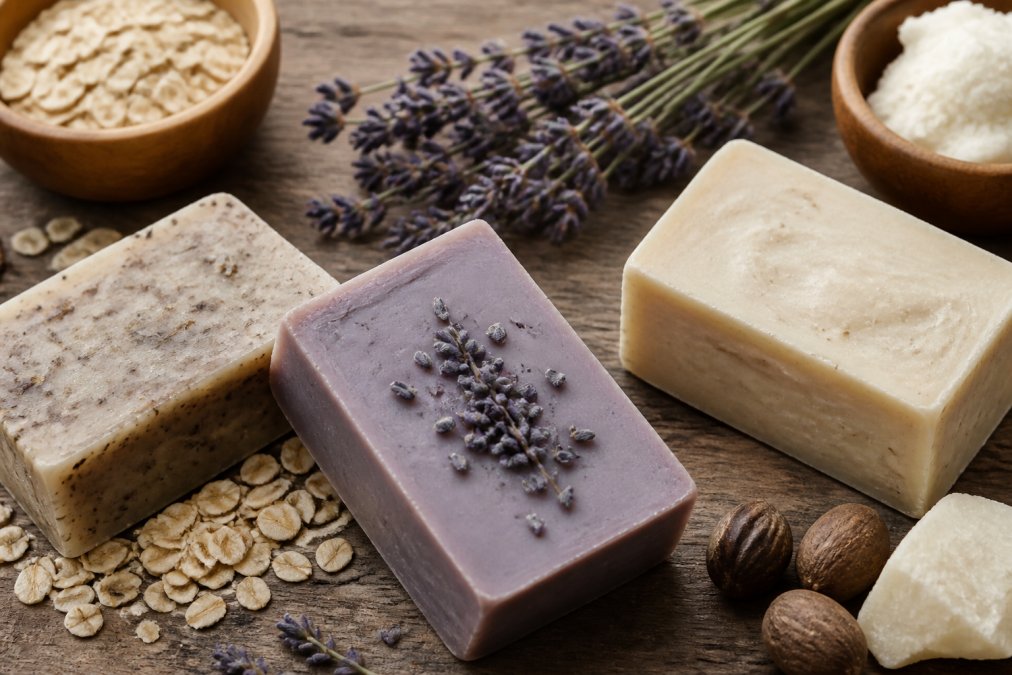
Sourced from the lavender fields of Bulgaria, this bar delivers genuine aromatherapeutic calm with every lather. Colloidal oats gently exfoliate and soothe, while nutrient-dense sea moss, rich in vitamins and minerals, deeply hydrates and supports your skin's natural barrier. The luxuriously bubbly lather cleanses without stripping, and the thick 5.3 oz bar is designed to last.
How to Store Artisan Soap Bars for Maximum Life
A common mistake is leaving soap sitting in a puddle of water between uses. That single habit can cut a bar's lifespan in half. To store artisan soap bars properly, keep them on a well-draining soap dish that allows air to circulate underneath. A bar that dries out between uses will last significantly longer than one that stays wet.
For maximum longevity, consider rotating between two bars so each one has time to dry completely. Keep your soap away from direct streams of water when not in use, and avoid humid, enclosed soap dishes. With proper care, a handcrafted 7 oz bar can last four to six weeks of daily use.
Choosing an Eco Friendly Body Wash or Bar
When you compare a body wash to a bar soap, the environmental math is not just about packaging, it is about water weight, transportation emissions, and ingredient sourcing. A typical 16-ounce bottle of body wash is about 80% water by volume (the EPA). That water is heavy, which means every truckload of liquid soap carries significantly less actual cleansing product than an equivalent load of solid bars. Bar soaps are concentrated: a single 7-ounce bar replaces roughly two 16-ounce bottles of body wash in terms of washes per dollar. The carbon footprint difference is substantial before you even consider that most body washes still come in plastic pumps or bottles, while bars can ship in a simple paper wrapper.
But the deeper environmental question, and the one most brands avoid, is ingredient sourcing transparency. A bar labeled "eco-friendly" can still contain palm oil sourced from recently deforested land in Southeast Asia, or shea butter harvested under opaque labor conditions in West Africa. The term "natural" does not automatically mean sustainable or ethical. What separates a genuinely responsible small batch maker from others is whether they can name their supply chain.
Here is what to ask before you buy:
- Where does the palm oil come from? If a bar lists palm oil or sodium palmate, ask whether it is RSPO-certified sustainable. Many small batch makers avoid palm oil entirely, using coconut oil or olive oil instead, which sidesteps the deforestation issue altogether.
- Is the shea butter fair-trade? Shea is harvested by women's cooperatives in West Africa. Fair-trade certification ensures they receive a living wage, not just a commodity price. A brand that names its cooperative or region is more likely to be doing this.
- Are the botanicals traceable to a specific farm or region? When a maker says "Bulgarian lavender" or "French green clay," they are making a verifiable claim. Vague terms like "natural botanicals" with no geographic origin are a red flag.
- What is the water footprint of the ingredients? Some botanicals, like almond oil, require significant water to produce. Others, like oats, are relatively low-impact. A maker who discusses these trade-offs openly is more trustworthy than one who simply slaps a leaf on the label.
The most eco-friendly choice is not just a bar over a bottle, it is a bar from a maker who can tell you exactly where every ingredient came from and how it was processed. That level of transparency is only feasible at small batch scale, which is precisely why it is worth seeking out. When a producer names their olive grove in Tuscany or their shea cooperative in Ghana, they are inviting scrutiny. That is the kind of accountability that mass-market brands cannot offer.
What to Ignore in Natural Soap Marketing
The natural soap aisle is crowded with claims, and not all of them mean what you think. Terms like "aromatherapy" and "botanical" can be applied to bars that contain only a trace of essential oil alongside synthetic fragrance. The word "gentle" appears on products loaded with sulfates. Marketing language is not a substitute for reading the ingredient list.
What actually proves a soap is natural? Look for specific plant oils listed by name, such as olive oil, coconut oil, and shea butter. Check that fragrance comes from essential oils rather than unspecified "fragrance" or "parfum," which can hide synthetic chemicals. Verify that the bar is free from sulfates, parabens, and phthalates. And consider the maker's transparency about sourcing. A brand that tells you where its lavender comes from or how its bars are cured is far more trustworthy than one relying on vague eco-friendly buzzwords. Many brands also claim to be handcrafted, but batch codes and maker stories help confirm that claim.
| What to Look For | What to Ignore | Why It Matters |
|---|---|---|
| Named plant oils (olive, coconut, shea) | Vague "natural oils" | Confirms real botanical base |
| Essential oils listed specifically | Generic "fragrance" or "parfum" | Avoids hidden synthetic chemicals |
| Sulfate-free, paraben-free labels | "Gentle" or "dermatologist tested" | Verifies actual formulation |
| Transparent sourcing and batch codes | Generic "eco-friendly" claims | Proves small batch authenticity |
Conclusion: Find Your Botanical Match
The shift from commercial detergent bars to small batch botanical soaps is a shift toward intentional skincare. You gain a bar that respects your skin barrier, lasts longer with proper care, and avoids synthetic chemicals. The challenge is finding a maker who is honest about ingredients and committed to traditional methods.
Gracie & Co. 1942 has been handcrafting soap for over 60 years using 100% natural ingredients like organic olive oil, shea butter, and botanicals. Every bar is made in small batches with no sulfates, parabens, or synthetic fillers, and our formulations are vegan and cruelty-free. Explore our full collection of botanical soap bars to find the scent and ingredient profile that matches your skin. Get started with Gracie & Co. 1942 and make your daily cleanse a ritual your skin will thank you for.
Frequently Asked Questions
What is the most natural soap you can buy?
The most natural soaps are made using the cold process method with plant-based oils like olive, coconut, and castor oil. Look for bars that list botanicals, shea butter, and essential oils as key ingredients. A truly natural soap is free from sulfates, parabens, and phthalates. Small batch botanical soaps often retain glycerin naturally, which is a humectant that draws moisture to the skin. Always check the ingredient list for transparency and recognizable, skin-loving components.
Is small batch soap better for sensitive skin?
Yes, small batch soap is often a better choice for sensitive skin because it is made with natural ingredients and avoids the harsh detergents and synthetic fillers found in many commercial bars. The cold process method preserves the natural glycerin and nourishing properties of organic oils like olive oil and shea butter. Botanical soaps with finely ground oats, like our Manuka Honey Oats & Coconut Milk bar, provide gentle exfoliation without stripping the skin's natural barrier.
How can you tell if a botanical soap is truly natural?
Check the ingredient list for transparency. A truly natural botanical soap lists plant-based oils, butters, and botanical extracts first. It should be free from sulfates, parabens, phthalates, and synthetic fillers. Look for brands that are transparent about their sourcing and production methods, such as handcrafted in small batches. Certifications like cruelty-free and vegan are good indicators. Be wary of vague marketing terms; the ingredient list is the most honest proof of what is inside the bar.
How long do handcrafted botanical soap bars last?
A well-cured, handcrafted botanical soap bar can last between 4 to 6 weeks with daily use. To extend the life of your bar, store it on a well-draining soap dish that allows air to circulate, keeping it dry between uses. Avoid leaving it in standing water or directly under the stream of the shower. Thicker bars, like our 7 oz options, are crafted to be long-lasting.