

Is Handcrafted Soap Worth the Cost? A 2026 Look

Table of Contents
- What You Are Paying For: Ingredients vs. Detergents
- Handcrafted Soap vs Commercial Soap: The Real Differences
- The Benefits of Cold Process Soap for Your Skin
- Does Handcrafted Soap Last Longer? The Cost-Per-Wash Math
- How to Store Handmade Soap to Make It Last
- Allergies, Sensitivities, and Ingredient Transparency
- The Verdict: When It Is Worth the Cost
- Frequently Asked Questions
Last Updated: September 6, 2026
The question of whether handcrafted soap is worth the cost comes down to a simple comparison: what you pay per wash versus what you pay per bar. A $12 handcrafted bar that lasts a month in the shower often beats a $2 commercial bar that dissolves in a week, especially when you factor in skin health. At Gracie & Co. 1942, we have spent over 60 years crafting small-batch soap. This guide breaks down the real cost differences, the skincare benefits, and the longevity math so you can decide if the switch makes sense for you.
What You Are Paying For: Ingredients vs. Detergents
The price gap between a $2 drugstore bar and a $12 handcrafted bar starts with what is actually inside them. Mass-market soap is often not soap at all in the traditional sense; it is a blend of synthetic detergents and surfactants that strip the skin's natural oils. These bars rely on cheap raw materials like palm oil derivatives, petroleum-based foaming agents, and chemical preservatives to keep production costs low and shelf life long.
Handcrafted soap, by contrast, is built on plant oils like olive oil and shea butter that cost significantly more per pound. The saponification process, where oils react with lye to create true soap, also produces natural glycerin as a byproduct. Commercial manufacturers often extract that glycerin to sell separately for lotions, leaving their bars harsh and drying. Artisan makers leave the glycerin in, which is why handcrafted bars feel creamier and more moisturizing on the skin.
Handcrafted Soap vs Commercial Soap: The Real Differences
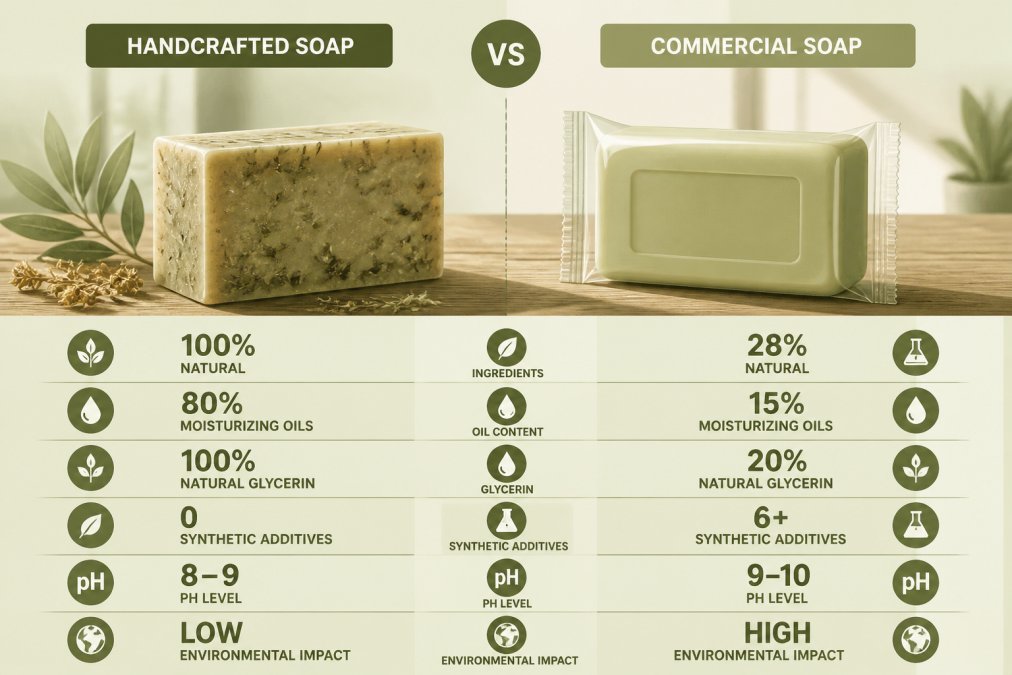
The differences between handcrafted soap vs commercial soap go beyond ingredients into how each bar is made and what it does to your skin. Commercial bars are manufactured in continuous processes that prioritize speed and uniformity. They often contain sulfates, parabens, and synthetic fragrances that can irritate sensitive skin and disrupt the skin barrier over time.
Handcrafted cold process soap is made in small batches, cured for weeks to allow excess water to evaporate, resulting in a harder, longer-lasting bar. This curing time is not just about texture; it concentrates the moisturizing properties and creates a milder, pH-balanced product. For anyone with skin sensitivity or conditions like eczema, the absence of synthetic detergents and the presence of superfatting, where extra oils are left unsaponified, makes a measurable difference in how the skin feels after cleansing.
| Feature | Handcrafted Cold Process Soap | Commercial Bar Soap |
|---|---|---|
| Base ingredients | Plant oils, shea butter, botanicals | Synthetic detergents, surfactants |
| Glycerin | Naturally retained | Often extracted and sold separately |
| Additives | Essential oils, botanical extracts | Parabens, sulfates, synthetic fragrances |
| Production method | Small-batch, cured for weeks | Mass-produced, continuous process |
| Effect on skin | Moisturizing, supports skin barrier | Can strip natural oils, may irritate |
The Benefits of Cold Process Soap for Your Skin
The benefits of cold process soap show up most clearly for people who struggle with dry, reactive, or sensitive skin. Because the cold process method preserves the natural glycerin and allows for superfatting, the finished bar cleanses without leaving your skin feeling tight or stripped. The olive oil and shea butter in many handcrafted formulas provide a layer of nourishment that commercial detergents simply do not offer.
The science comes down to pH and the skin barrier. Human skin has a naturally acidic pH of approximately 4.5 to 5.5, which supports the stratum corneum, the outermost layer that acts as a barrier against irritants and prevents transepidermal water loss. Most commercial bars are formulated at a pH of 9 to 10, which is strongly alkaline. Washing with an alkaline product temporarily disrupts the acid mantle, and the skin must expend energy over the next several hours to restore its natural pH, leaving it more vulnerable to irritation, bacterial overgrowth, and moisture loss.
Cold process soap, when properly formulated with a superfat percentage between 5 and 8 percent, typically lands at a pH of 8 to 9. That is still alkaline, but measurably closer to the skin's natural range than commercial bars. More importantly, the unsaponified oils left behind by superfatting act as a buffer, depositing a thin occlusive layer that helps retain moisture during and after the wash. Repeated use of high-pH cleansers correlates with increased skin dryness and irritation, particularly in individuals with compromised barrier function.
A common mistake is assuming all "natural" soaps are the same. Melt and pour bases, for instance, are technically handcrafted but start from a pre-made commercial base that often includes synthetic detergents and can be formulated at a higher pH. True cold process soap is made from scratch, giving the maker full control over every ingredient, including the final pH and the superfat percentage. This matters for ingredient transparency: you know exactly what is touching your skin, with no hidden preservatives or undisclosed fillers.
For individuals managing eczema or psoriasis, the choice of cleanser is not cosmetic; it is part of a treatment protocol. The National Eczema Association recognizes that harsh soaps can trigger flares by stripping the skin barrier. While no soap is a medical treatment, a cold process bar with a high olive oil content and no fragrance is frequently recommended by dermatologists as a non-irritating alternative to commercial bars. The absence of sulfates and synthetic detergents removes a common trigger, and the retained glycerin acts as a humectant, drawing water into the stratum corneum rather than allowing it to evaporate after cleansing.
Does Handcrafted Soap Last Longer? The Cost-Per-Wash Math
Handcrafted soap does last longer than most commercial bars, and the cost-per-wash math is where the value becomes clear. A dense, well-cured cold process bar is harder and less prone to dissolving into a mushy puddle on your shower shelf. Most users find a single handcrafted bar lasts three to four weeks with daily use, compared to one to two weeks for a commercial bar that softens quickly when wet.
But the honest comparison is not just bar-to-bar; it is bar-to-bottle. A standard 16-ounce bottle of body wash costs between $4 and $8 and typically delivers about 20 to 25 washes, putting the cost per wash at roughly $0.16 to $0.40. A $12 handcrafted bar that lasts 28 days with one daily shower delivers 28 washes, putting its cost per wash at about $0.43. On the surface, the liquid appears cheaper.
However, the lifecycle analysis does not end at the pump. Liquid body wash is roughly 60 to 80 percent water by volume, so you are paying to ship and store water in a plastic bottle. The thin viscosity encourages over-pouring, often using 5 to 8 milliliters per wash, while a dense bar requires only a few swipes to build a rich lather. When measured by grams of actual cleansing agent per wash, the handcrafted bar often delivers a lower cost per effective use.
The other hidden cost is the packaging. A single 16-ounce liquid body wash bottle uses roughly 25 to 30 grams of plastic, and the pump mechanism adds another 5 to 10 grams of mixed-material waste that is rarely recyclable curbside. Over a year of daily showers, a liquid-body-wash user will go through approximately 12 to 15 bottles, generating nearly a pound of plastic waste. A handcrafted bar user will go through 12 to 13 bars in the same period, generating zero plastic if the bars are purchased naked or in paper wrap. Municipal recycling programs in the United States accept only about 30 percent of personal-care plastic bottles, meaning the majority of that annual pound ends up in a landfill or incinerator.
There is also the question of how you use the bar. To make the bar last, keep it dry between uses and let it sit on a draining soap dish rather than in standing water. When you divide the price of a handcrafted bar, say $11 to $15, by the number of washes you actually get, the cost per use often lands close to or below what you would pay for a cheaper bar you replace twice as often.
How to Store Handmade Soap to Make It Last
Learning how to store handmade soap to make it last is straightforward, and the payoff is a bar that holds its quality for weeks. The two enemies of a soap bar are standing water and heat. A wet bar sitting in a puddle will soften and dissolve rapidly, wasting your money. A dry bar on a well-draining dish will stay firm and produce a rich lather for much longer.
- Use a slotted or ribbed soap dish that allows water to drain away, not a flat saucer.
- Keep the bar out of direct streams of water when you are not using it.
- Rotate between two bars so each one has time to dry completely between uses.
- Store extra bars in a cool, dry place away from humidity to preserve the essential oils.
With proper storage, most handcrafted bars will outlast their commercial counterparts, reinforcing the cost-per-wash argument. This is the practical side of the value equation: a premium product only pays off if you treat it correctly.
Allergies, Sensitivities, and Ingredient Transparency
For anyone with allergies or skin sensitivities, handcrafted soap offers a level of ingredient transparency that mass-market labels rarely provide. Commercial bars can hide dozens of chemical compounds behind vague terms like "fragrance," which often contains phthalates and synthetic musks that trigger reactions. Artisan makers typically list every oil, butter, and essential oil used, making it easier to identify and avoid triggers.
That said, natural is not automatically hypoallergenic. Essential oils are potent botanical extracts, and some people are sensitive to citrus oils or other fragrant additions. If you have reactive skin, look for unscented bars or those with gentle, low-sensitivity profiles like olive oil and shea butter without added fragrance. The American Academy of Dermatology guidance on sensitive skin recommends patch testing any new product, including natural soap, before full use. The FDA labeling requirements for cosmetics also require full ingredient disclosure, so a brand that lists everything clearly is a good sign of accountability. For those who have reacted to every "natural" brand they have tried, a simple olive oil and shea butter bar with no essential oils is often the safest starting point, and the National Eczema Association resource on irritants confirms that fragrance is a common trigger to avoid.
The Verdict: When It Is Worth the Cost
Handcrafted soap is worth the cost when you value skin health, ingredient transparency, and a product that actually lasts. If you have sensitive skin that reacts to synthetic detergents, if you are tired of dry winter skin that no drugstore bar seems to fix, or if you want to reduce packaging waste by buying a single bar that lasts a month, the premium price is justified. The benefits of cold process soap, from glycerin retention to superfatting, deliver a genuinely different result than a commercial bar.
Where it is not worth it is if you simply want the cheapest possible way to get clean and have no skin concerns. Mass-market soap works fine for many people, and there is no shame in that. But for the health-conscious adult who reads labels, the eco-conscious shopper who wants biodegradable ingredients and less plastic, and anyone who treats their daily shower as a ritual rather than a chore, a handcrafted bar is a small luxury that pays for itself. At Gracie & Co. 1942, our bars are made with 100% natural ingredients, no sulfates, parabens, or synthetic fillers, and each one is crafted in small batches with over 60 years of family tradition behind it.
Choosing between a $3 commercial bar and a $13 handcrafted bar is really a choice about what you want your skincare routine to do for you. If you are ready to try a bar that nourishes your skin instead of stripping it, with transparent ingredients and a scent profile that turns a shower into a ritual, our collection has an option for you. Explore our shea butter soap bars, from the citrus warmth of Orange Patchouli to the coastal freshness of Sea Salt Agave, and feel the difference that small-batch craftsmanship makes. Get started with Gracie & Co. 1942 and give your skin the care it deserves.

Frequently Asked Questions
How much should handmade soap cost?
Prices vary widely based on ingredients and branding, but a reasonable range for a quality 5-7 oz bar is between $10 and $16. A bar like Gracie & Co. 1942's 5 oz Orange Patchouli at $12 or the 7 oz Champagne Kisses at $15 reflects the cost of plant oils, essential oils, and the labor of small-batch production. Bars priced below $5 often cut corners with synthetic fragrance oils or cheaper base ingredients.
Does handcrafted soap last longer than store-bought bars?
Yes, when cared for properly. Handcrafted soap bars are dense and hard because of the curing process, which allows water to evaporate. This density means they dissolve slower than mass-produced bars that are often softer and filled with synthetic detergents. To maximize lifespan, store the bar on a well-draining soap dish between uses and keep it away from direct streams of water.
Is handcrafted soap better for sensitive skin?
Often, yes. Handcrafted cold process soap retains glycerin, a humectant that draws moisture to the skin, whereas commercial manufacturers often extract glycerin for use in lotions. Many handcrafted bars also avoid synthetic detergents, parabens, and sulfates that can strip the skin barrier. However, individual reactions vary, so check the ingredient list for potential allergens like essential oils if you have known sensitivities.
What is the difference between handcrafted soap and commercial soap?
The main difference is the cleansing agent. True handcrafted soap is made through saponification, where oils like olive oil and shea butter react with lye to create soap and natural glycerin. Most commercial bars are not actually soap; they are synthetic detergent bars that use surfactants to clean. These detergents can be harsher on the skin's pH balance and often strip natural oils, leading to dryness.