

Avoiding Parabens in Skincare: The 2026 Guide

Table of Contents
- What Are Parabens and Why Are They in Your Skincare?
- The Paraben Controversy: Separating Fear from Fact
- How to Read Skincare Labels for Parabens
- The Preservative Paradox: Why 'Paraben-Free' Isn't Always Safer
- Natural Preservatives in Skincare: What Actually Works
- Paraben-Free Skincare Benefits for Sensitive Skin
- Your Practical Guide to Avoiding Parabens Every Day
- Conclusion: Cleaner Choices for Healthier Skin
- Frequently Asked Questions
Last Updated: September 9, 2026
What Are Parabens and Why Are They in Your Skincare?
Parabens are a class of synthetic chemical compounds used as preservatives in cosmetics and personal care products to prevent microbial growth and extend shelf life. These ingredients have been a standard in the beauty industry for decades because they are inexpensive, highly effective, and stable across various formulations. When you scan the ingredient list on your moisturizer, shampoo, or body wash, names ending in "paraben" signal their presence.

The concern around avoiding parabens in skincare products stems from research suggesting they can mimic estrogen in the body, classifying them as potential endocrine disruptors. This has led many health-conscious consumers to scrutinize their daily routines more closely. At Gracie & Co. 1942, we have crafted natural bath and body products for over 60 years, and we believe understanding what touches your skin matters.
Most guides get this wrong by presenting parabens as either entirely dangerous or completely harmless. The truth sits in the nuance of exposure levels, dermal absorption rates, and the alternatives available. Below, we will show you exactly how to identify these ingredients, understand the real risks, and make informed swaps without falling for marketing fear.
The Paraben Controversy: Separating Fear from Fact
The debate over paraben safety intensified after a 2004 study detected these compounds in breast tumor tissue, raising questions about their role in hormone-related cancers (PubMed). Regulatory bodies have since reviewed the evidence extensively, and the picture is far more nuanced than either 'safe' or 'dangerous.' Understanding the specific regulatory landscape and the scientific mechanisms at play is key to making an informed choice.
The Regulatory Reality: A Tale of Two Frameworks
The most significant regulatory divergence is between the United States and the European Union. In the U.S., the FDA does not have the same pre-market approval authority over cosmetics as it does over drugs. Under the Federal Food, Drug, and Cosmetic Act, cosmetics and their ingredients, with the exception of color additives, do not require FDA approval before they go on the market. The FDA's role is primarily post-market, meaning it can take action if a product is found to be adulterated or misbranded, but it does not proactively review preservative safety. The agency has stated that it has no evidence that parabens as used in cosmetics are harmful, but it continues to evaluate new data.
In contrast, the European Union operates under a more precautionary framework. The EU's cosmetics regulation (EC) No 1223/2009 is more prescriptive. It has banned five parabens outright, isopropylparaben, isobutylparaben, phenylparaben, benzylparaben, and pentylparaben, and has imposed strict concentration limits on others (ec.europa.eu). For example, methylparaben and ethylparaben are allowed only up to 0.4% each, and propylparaben and butylparaben are allowed only up to 0.14% each when used alone. This regulatory divergence is a major point of confusion for consumers, as a product sold in the U.S. may contain a paraben at a concentration that would be illegal in the EU.
The Scientific Mechanism: Why the 'Estrogen Mimic' Concern Exists
The concern around parabens stems from their ability to bind to estrogen receptors in the body, a property known as estrogenic activity. However, the key scientific question is one of potency and exposure. The estrogenic activity of parabens is estimated to be 1,000 to 1,000,000 times weaker than that of estradiol, the primary human estrogen (peer-reviewed research). This means that for a paraben to have a measurable hormonal effect, you would need to be exposed to a concentration far higher than what is typically found in a cosmetic product.
What often gets lost in the fear is that regulatory oversight considers concentration limits, not just presence. Most concerns focus on long-chain parabens like propylparaben and butylparaben, which show stronger estrogenic activity than their shorter-chain relatives (methyl and ethyl). However, the scientific community does not universally agree on the real-world risk at typical cosmetic concentrations, especially when considering that the 2004 study that sparked the controversy has been criticized for its methodology and has not been consistently replicated.
For consumers, the practical takeaway involves understanding that dermatological safety depends on the full formulation, not a single ingredient. The controversy has driven genuine innovation in preservation, but it has also created a market where fear sometimes outweighs evidence. A more productive approach is to weigh the known, well-characterized profile of parabens against the less-defined profiles of newer alternatives, and to prioritize products with a preservation system that is both effective and appropriate for the product's water content.
How to Read Skincare Labels for Parabens
Reading an ingredient list requires knowing that cosmetics list components in descending order of concentration, though ingredients under one percent can appear in any order. This means the preservatives you want to identify often hide near the end of the list, making a quick scan insufficient for thorough label reading. To truly master label reading, you need a systematic approach that goes beyond just looking for the suffix '-paraben'.
Step 1: Master the Standard Nomenclature
The FDA's labeling regulations require cosmetics to list ingredients using their common or usual names, which for parabens means the International Nomenclature of Cosmetic Ingredients (INCI) names. The most common types you will encounter are methylparaben, ethylparaben, propylparaben, and butylparaben, often used in combination to protect against a broader range of microbes. You might also see isobutylparaben or benzylparaben in some formulations, though these appear less frequently in mainstream products.
Step 2: Decode the 'Hidden' Parabens
The critical skill competitors often miss is recognizing parabens that don't end with the '-paraben' suffix. Under INCI rules, parabens can also be listed under their chemical family name: alkyl parahydroxy benzoates. Look for terms like:
- Methyl parahydroxybenzoate (chemically identical to methylparaben)
- Ethyl parahydroxybenzoate (chemically identical to ethylparaben)
- Propyl parahydroxybenzoate (chemically identical to propylparaben)
- Butyl parahydroxybenzoate (chemically identical to butylparaben)
Some products may also use the abbreviation 'PHB' or list the parent compound, 'parahydroxybenzoic acid,' which is the building block for all parabens. A truly thorough label audit includes checking for these alternative names.
Step 3: Scan the Entire List, Not Just the End
While preservatives are often at the end, this isn't always the case. In products with a high water content and few active ingredients, the preservative system can appear in the middle of the list. Furthermore, some products use a 'cocktail' of preservatives, each at a low concentration, which allows them to be listed in any order after the 1% mark. This means you must scan the entire list, not just the final five ingredients.
Step 4: Audit Every Product Category
Many consumers check their lotions and cleansers but forget about products that rinse off quickly. Shampoos, conditioners, shaving creams, and body washes frequently contain parabens because their water-based formulas are vulnerable to contamination. Even some makeup products, deodorants, and sunscreen formulations rely on these preservatives, so a complete audit of your routine requires checking every personal care product you use.
Step 5: Use the 'Water Test' to Prioritize Your Efforts
A quick heuristic is to check if the product's first ingredient is 'Water' (or 'Aqua'). If it is, the product requires a preservative system, and you should scrutinize the label closely. If the product is anhydrous (water-free), like a solid lotion bar or a pure oil, it is far less likely to contain parabens, as they are unnecessary in that environment. This simple test can help you focus your label-reading energy on the products that pose the highest risk.

The Preservative Paradox: Why 'Paraben-Free' Isn't Always Safer
The Preservative Paradox describes a tension that most consumers never hear about: removing parabens without adding a comparable alternative can compromise product safety. Preservatives exist to prevent harmful microbial growth, including bacteria and mold that can cause skin infections, especially in water-based products.
When a brand removes parabens, it must replace them with something that offers equivalent antimicrobial properties. Some brands opt for fewer or weaker preservatives to appeal to the "clean" market, which can shorten shelf life and increase contamination risk. This trade-off matters because a contaminated product poses a more immediate health threat than the theoretical long-term risk of paraben exposure.
The smartest approach involves looking for products that balance preservation with gentler alternatives. Water-free formulations offer one elegant solution, since bacteria require water to thrive. Solid lotion bars, whipped butters, and oil-based cleansers naturally resist microbial growth without needing the same preservative load as their water-based counterparts.
Natural Preservatives in Skincare: What Actually Works
Natural preservatives in skincare have advanced considerably, offering viable alternatives for brands committed to cleaner formulations. Grapefruit seed extract, rosemary extract, and certain essential oils demonstrate antimicrobial properties, though often requiring higher concentrations than synthetic options to achieve the same protection.
The challenge with natural preservation is stability. Plant-based extracts can vary in potency based on harvest conditions, making consistent protection harder to guarantee. This is why many formulators combine several natural preservatives or use fermentation-derived compounds like gluconolactone, which offers broad-spectrum protection with a gentle profile.
Shelf Life and Product Stability Without Parabens
Removing parabens typically shortens a product's shelf life from around three years to six to twelve months, depending on the formulation. This requires brands to rethink packaging, batch sizes, and distribution timelines. Small-batch production offers a distinct advantage here, since products reach consumers closer to their manufacturing date.
Water-free formulations sidestep the preservation challenge entirely. Our Ultimate Moisture Solid Shea Butter Lotion Bar contains no water, meaning bacteria cannot thrive in it, so it needs no harsh preservatives to remain safe. The trade-off is a different application experience, but the result is a product that stays stable while using only butters, waxes, and botanical oils.
Paraben-Free Skincare Benefits for Sensitive Skin
Paraben-free skincare benefits extend beyond the theoretical concerns about endocrine disruption, offering tangible advantages for those with reactive complexions. Some individuals experience allergic reactions or contact dermatitis from paraben exposure, manifesting as redness, itching, or flaking after using conventional products.
For sensitive skin, simpler formulations often mean fewer potential irritants overall. Brands focused on natural preservation tend to use shorter ingredient lists, reducing the cumulative exposure to synthetic chemicals that can trigger reactions. This aligns with the experience of many consumers who find that switching to botanical-based products calms persistent irritation.
The moisturizing profile also differs meaningfully. Natural butters like shea and mango provide rich fatty acids that support the skin barrier, whereas conventional lotions often rely on water and emulsifiers that can strip or disrupt sensitive skin. Products like our Silk Radiance Organic Body Butter deliver concentrated nourishment without the dilution that requires heavier preservation.

Your Practical Guide to Avoiding Parabens Every Day
Building a paraben-free routine does not require throwing away everything at once. Start with the products that stay on your skin longest, since dermal exposure increases with contact time. Leave-on products like moisturizers, body butters, and lotions deserve priority over rinse-off items like body wash.
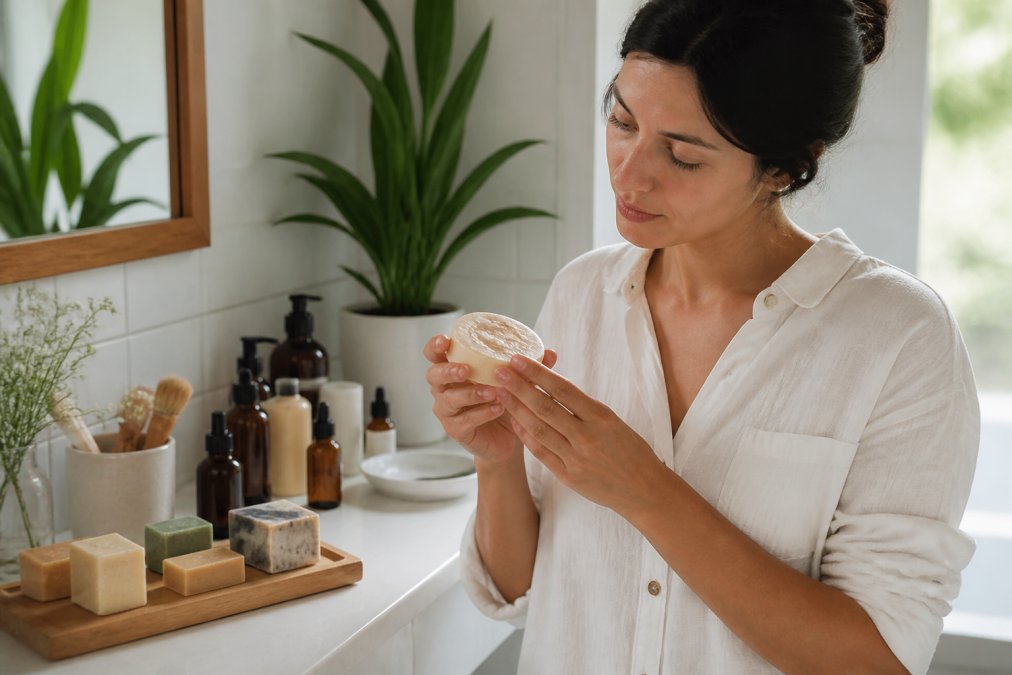
Next, develop a simple scanning habit for every new purchase. Check the ingredient list for the four common paraben types, then verify the product's water content. A water-free solid moisturizer or body butter eliminates the preservation concern entirely, while water-based products require a closer look at their preservative system.
Consider the practical economics as well. Premium natural products often cost more upfront, but concentrated water-free formulas typically last longer per application than diluted conventional lotions. Comparing cost per use rather than price per jar gives a more accurate picture of value.
| Product Type | Paraben Risk | Water-Free Alternative | Typical Longevity |
|---|---|---|---|
| Body Lotion | High (water-based) | Solid lotion bar | 2-3 months daily use |
| Body Butter | Medium | Whipped organic butter | 1-2 months daily use |
| Body Wash | High (water-based) | Whipped soap with shea | 1-2 months |
| Hand Cream | High | Solid balm or butter | 2-3 months |
Conclusion: Cleaner Choices for Healthier Skin
Navigating the paraben conversation requires balancing legitimate safety concerns against the practical necessity of preservation. The path forward involves choosing formulations that minimize risk without compromising product integrity. Water-free, small-batch products offer a compelling answer by removing the conditions that make preservatives necessary in the first place.
At Gracie & Co. 1942, our heritage of handcrafted, small-batch production means every bar and butter is made with intention using 100% natural ingredients, free from sulfates, parabens, and synthetic fillers. Our cruelty-free formulations prioritize your skin's health while honoring over six decades of family tradition. Get started with Gracie & Co. 1942 and experience skincare that works with your body, not against it.
Frequently Asked Questions
What are the most common parabens to avoid in skincare?
The most common parabens are methylparaben, propylparaben, butylparaben, and ethylparaben. On an ingredient list, they usually appear with the prefix 'methyl-', 'ethyl-', 'propyl-', or 'butyl-' followed by 'paraben'. You might also see them listed under the broader term 'parabens' or as E-numbers like E218 and E214. If you are avoiding parabens, scan the full ingredient list for these specific chemical compounds, not just the word 'paraben'.
Are parabens actually harmful to human health?
The scientific community remains divided. The FDA considers parabens safe for use in cosmetics at current levels, while the European Union has banned certain parabens and restricted others due to concerns about endocrine disruption. Studies have shown parabens can mimic estrogen in the body, but the clinical significance of this at the low levels found in skincare is still debated. For many people, avoiding parabens is a precautionary choice based on the potential for hormone mimicry.
What's worse, parabens or sulfates?
Neither is categorically 'worse' because they serve different functions. Sulfates are detergents that create foam and remove oil, and they can strip the skin of its natural moisture barrier, causing irritation for those with sensitive skin. Parabens are preservatives that prevent microbial growth. If you are concerned about irritation, you might avoid sulfates. If your concern is about potential endocrine-disrupting effects, you would prioritize avoiding parabens. Many natural brands, including ours, formulate without either.
Do natural preservatives work as well as parabens?
Yes, when formulated correctly. Natural preservatives like grapefruit seed extract, rosemary extract, and vitamin E, combined with proper packaging and low-water formulas, can effectively prevent microbial growth. The key is product design. Water-free products, like our solid shea butter lotion bar, naturally resist bacteria and mold, so they need fewer preservatives overall. This approach maintains product stability and shelf life without relying on synthetic chemical compounds.
Is there a difference between paraben-free and clean beauty?
Yes, the terms are not interchangeable. 'Paraben-free' specifically means the product contains no parabens, but it could still contain other synthetic chemicals, fragrances, or sulfates. 'Clean beauty' is a broader, unregulated term that typically implies avoiding a wider range of potentially harmful ingredients, including parabens, phthalates, and sulfates. When choosing products, do not assume paraben-free means fully natural. Always read the complete ingredient list to understand what is actually inside.